Outgunned by Data: How Institutional Traders See the Crypto Market Before You Do
There is a persistent myth in cryptocurrency investing: that the market's decentralized nature creates a level playing field. The blockchain is open, the data is public, and anyone with an internet connection can participate. In theory, this is true. In practice, it is one of the most expensive misconceptions a retail investor can carry into the market.
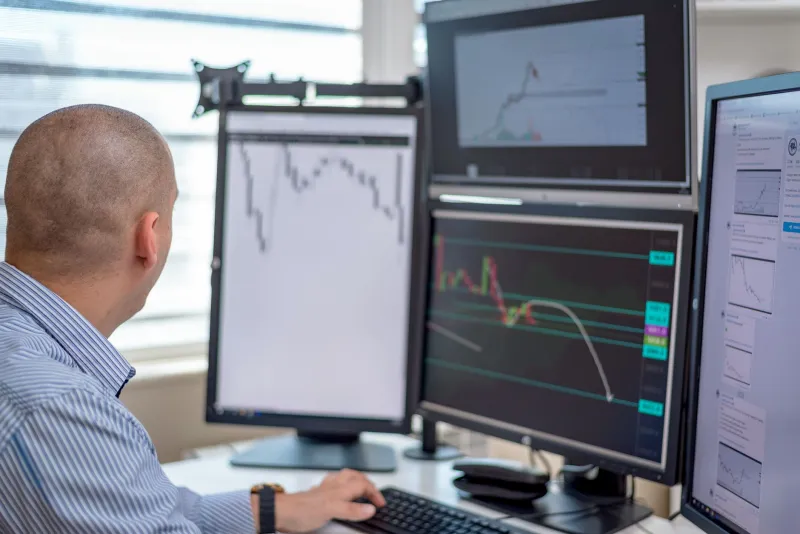
The reality is that professional traders and institutional desks are not simply working harder or thinking more clearly than individual investors. They are operating with fundamentally superior infrastructure—data pipelines, API architecture, and real-time monitoring systems that transform raw blockchain activity into actionable intelligence before most retail participants have even opened their trading apps.
Understanding this divide is not an exercise in pessimism. It is the first step toward making more informed decisions about where, when, and how to deploy capital in a market where information asymmetry is one of the most consequential risks you face.
The Latency Advantage Nobody Talks About
When professionals discuss "alpha" in cryptocurrency markets, they are referring to returns generated above a given benchmark. A significant portion of institutional alpha is not derived from superior judgment—it is derived from superior speed and data resolution.
Large trading desks maintain direct API connections to multiple exchanges simultaneously, ingesting order book data at the millisecond level. They are not watching a price chart refresh every few seconds. They are monitoring the depth and composition of liquidity in real time, identifying when large orders are being staged, broken into smaller tranches, or withdrawn entirely. By the time a price movement appears on a standard retail charting platform, the institutional desk has already acted on the information that caused it.
This latency gap is compounded by co-location services—arrangements where trading infrastructure is physically positioned in close proximity to exchange servers. While this practice is more commonly associated with traditional equity markets, sophisticated crypto operations have adopted analogous strategies, particularly on high-volume centralized exchanges.
On-Chain Intelligence as a Competitive Weapon
Beyond exchange-level data, institutional participants have invested heavily in on-chain analytics—the systematic monitoring of blockchain transaction data to infer market behavior before it manifests in price.
Consider what on-chain data actually reveals: wallet accumulation patterns, the movement of assets between cold storage and exchange hot wallets, miner behavior, the flow of stablecoins into and out of DeFi protocols, and the activity of wallets historically associated with early project insiders. Each of these data streams, when properly interpreted, offers a window into market positioning that no price chart can provide.
Firms like Glassnode, Nansen, and Chainalysis have built entire business models around packaging this intelligence for institutional clients. Their enterprise tiers offer features—custom alerts, wallet clustering, entity labeling, and historical cohort analysis—that are either unavailable or prohibitively expensive for individual investors operating on retail budgets.
The practical consequence is stark. When a major holder begins quietly distributing a position across dozens of wallets, institutional clients with access to sophisticated clustering algorithms may detect the pattern within hours. Retail investors typically discover the same information when the selling pressure finally hits the price—often days later.
The Mempool Frontier
One of the least discussed information edges in professional crypto trading involves mempool monitoring—the practice of watching pending, unconfirmed transactions on a blockchain before they are included in a block.
The mempool is, in effect, a public waiting room for transactions. Any sufficiently technical participant can observe it. But transforming that raw stream into tradeable intelligence requires significant engineering resources: custom node infrastructure, sophisticated filtering systems, and the analytical capacity to distinguish meaningful signals from noise in a continuous flood of transaction data.
Institutional operations use mempool monitoring to anticipate large trades, identify arbitrage opportunities across decentralized exchanges, and in some cases, engage in strategies that exploit transaction ordering—a practice that has generated substantial controversy within the DeFi ecosystem. For retail investors without the technical infrastructure to participate in this layer of the market, it represents a category of activity that is effectively invisible.
Where the Playing Field Is Actually Shifting
The picture painted above is not entirely without remedy. A meaningful number of platforms have emerged with the explicit goal of democratizing access to professional-grade crypto intelligence, and the most serious individual investors are beginning to incorporate them into their analytical workflows.
Nansen's retail-accessible tiers, while less comprehensive than their institutional offerings, provide wallet labeling and smart money tracking features that were simply unavailable to individual investors five years ago. Token Terminal offers financial metrics—revenue, earnings, price-to-sales ratios—applied to blockchain protocols in a format that mirrors the fundamental analysis frameworks used in traditional equity research. Dune Analytics enables investors with SQL proficiency to construct custom on-chain dashboards, pulling directly from raw blockchain data without requiring proprietary data licensing.
For investors focused on derivatives markets, platforms such as Coinglass aggregate funding rates, open interest, and liquidation data across major exchanges—information that provides meaningful context for understanding leverage positioning and the potential for cascading liquidation events.
None of these tools eliminate the institutional advantage entirely. But they represent a genuine shift in what is accessible to a prepared, disciplined individual investor willing to invest time in developing data literacy.
Building a Personal Data Infrastructure
For US-based investors looking to meaningfully improve their informational position, the approach need not be overwhelming. A practical starting point involves constructing a layered monitoring system that addresses the most exploitable blind spots in typical retail analysis.
At minimum, this means moving beyond price and volume as primary decision inputs. Supplementing chart analysis with on-chain flow data—particularly exchange inflow and outflow metrics—provides context that price action alone cannot offer. Monitoring funding rates across perpetual futures markets offers a reliable proxy for aggregate market sentiment and leverage exposure. Tracking stablecoin movements into DeFi protocols can provide early signals about risk appetite shifts within the ecosystem.
Beyond data sourcing, the discipline of structured analytical review matters enormously. Institutional desks operate with defined processes: regular reviews of positioning, systematic evaluation of new data against existing theses, and documented decision frameworks that reduce the influence of emotional response. Individual investors who adopt even a simplified version of this rigor gain a meaningful edge over the majority of retail participants who are reacting to price movement rather than anticipating it.
The Honest Assessment
The cryptocurrency market's information asymmetry is real, consequential, and unlikely to disappear. Institutional participants will continue to invest in infrastructure that outpaces what is accessible to individual investors, and the gap in certain dimensions—particularly latency and raw data resolution—may never fully close.
What can change, and what is changing, is the quality of analysis that a prepared retail investor can bring to bear. The tools exist. The data is increasingly accessible. The question is whether individual investors are willing to treat information infrastructure as a genuine component of their investment strategy rather than an afterthought.
In a market where being out-traded by better data is the norm, the investors who acknowledge that reality and respond with discipline are the ones most likely to be standing when the dust settles.